Three Core Services. One Focus.
Everything I do is aimed at the same outcome: an ERP that the business actually runs through — not around
ERP Diagnostic Assessment
Most client engagements begin with the ERP Diagnostic Assessment. Leadership knows the ERP is not delivering the expected business results, but the underlying causes are not yet clear.
Duration: 3–4 weeks • Scope: Fixed • Deliverable: Root-cause diagnosis and a prioritized stabilization roadmap
Common triggers include:
Inventory cannot be trusted.
Planning has moved back to Excel.
Service levels are deteriorating.
Reporting is questioned during leadership meetings.
Employees continue to rely on spreadsheets and workarounds.
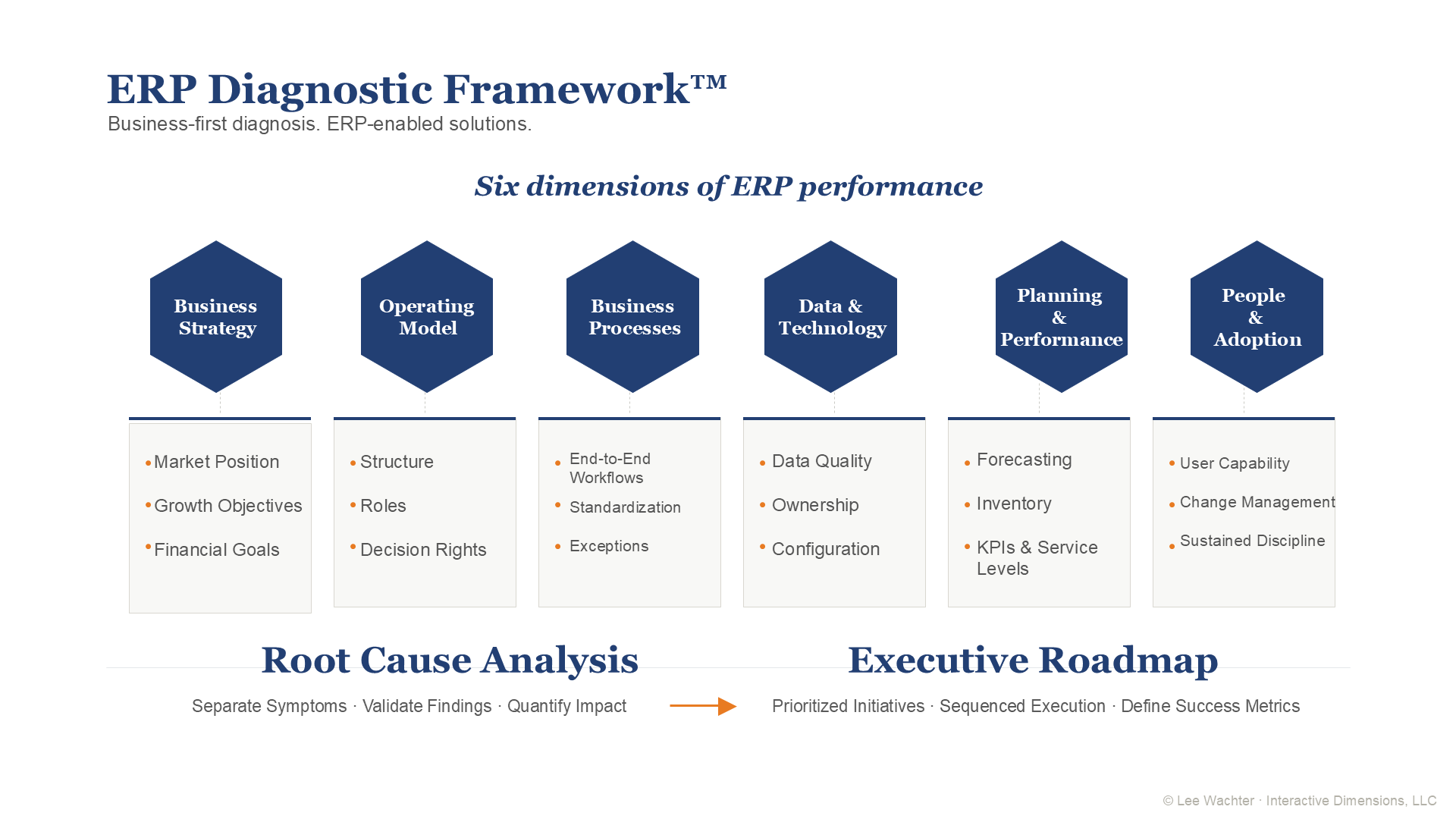
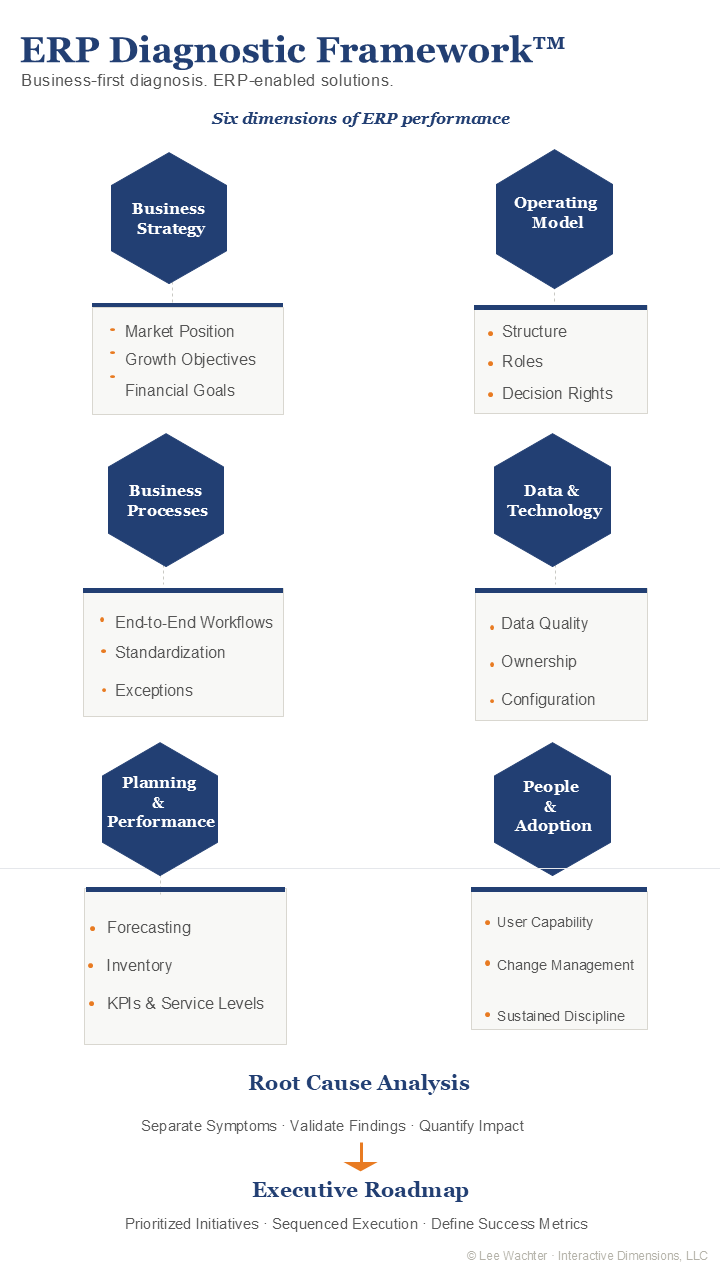
Organizations often don't know whether the underlying problem lies in data, process design, system configuration, governance, or post-go-live operating discipline.
The assessment separates symptoms from root causes and delivers a prioritized stabilization roadmap based on interviews with the people who use the system every day—not just the people who approved the implementation.
ERP Stabilization
The core engagement.
Duration: 60–90 days • Structure: Hands-on, embedded • Deliverable: A stabilized ERP environment, restored operational discipline, and measurable improvements in inventory accuracy, planning confidence, service levels, reporting, and decision quality.
Most stabilization work follows a Diagnostic Assessment. Occasionally, a client already has enough clarity to move directly into execution.
I work alongside leadership, operations, IT, and implementation partners to restore trust in the ERP and rebuild the operating discipline required to run the business through the system. This is not a report-and-leave engagement. It is a hands-on partnership focused on restoring the ERP as a trusted system of record and enabling the business to achieve the results it was originally expected to deliver.
Representative outcomes have included:
50% reduction in pick-and-pack time
$2.5 million inventory reduction
95% reduction in customer chargebacks
35% improvement in order accuracy
That may include redesigning planning parameters, improving master data, clarifying ownership, redesigning workflows, improving reporting, aligning departments, addressing implementation gaps, and establishing governance routines that were never fully implemented after go-live.
Best suited for:
Organizations that have completed a Diagnostic Assessment and are ready to execute, or companies with sufficient internal clarity that need an experienced operator to lead the stabilization effort.
ERP Implementation Rescue
For ERP programs that are moving in the wrong direction.
Typical engagement: Executive intervention during an active implementation • Focus: Recovery, realignment, and execution • Deliverable: A practical recovery plan and renewed leadership confidence
When a program is in trouble—timelines are slipping, costs are rising, scope is expanding, and confidence is declining—the usual response is to keep pushing. That rarely fixes the problem.
I step in to diagnose root causes, separate what is recoverable from what needs to be redesigned, realign the program with operational reality, and restore momentum and leadership confidence.
Typical warning signs include:
Missed milestones
Budget overruns
Scope creep
Declining user confidence
Growing dependence on consultants
Weak governance
Escalating executive concern
Typical deliverables include:
Program triage and risk assessment
Governance redesign
Recovery roadmap
Vendor and implementation partner alignment
Go/no-go recommendations
Executive status reporting
The objective is not to protect the project plan. It is to protect the business outcome.
Best suited for:
Private equity operating partners and executive leadership teams managing ERP programs that are behind schedule, over budget, losing momentum, or no longer aligned with business objectives.
The output is direct and practical: what is broken, why it is broken, what matters most, and what should change in what order.
This engagement is intentionally fixed in scope. It gives leadership a low-risk entry point and a high-value decision document before committing to a larger stabilization effort.
Best suited for: CEOs, COOs, CFOs, and private equity operating partners who need an independent diagnosis before committing additional capital, time, or organizational energy to the ERP environment.
Stabilize first. Optimize second.
Once the ERP is stable and operating as a trusted system of record, there is a natural next step: using the data to drive better decisions.
I help clients develop practical roadmaps for demand forecasting, inventory optimization, S&OP process redesign, and AI-enabled decision support. But this work only creates value when the underlying data and operating processes are reliable.
AI will not fix a weak ERP foundation. More often, it exposes it.
Companies need trustworthy data, clear ownership, disciplined processes, and a reliable system of record before advanced analytics can produce meaningful results.
ERP Selection & Modernization
Selecting a new ERP platform is one of the most important business decisions an executive team will make. Too often, organizations begin by evaluating software before they have clearly defined the business they want to become.
My approach is grounded in the same philosophy that has guided my work throughout my career: first define the future operating model, business processes, and strategic objectives, then select the technology that best supports them.
Technology decisions should support business strategy, not drive it.
Whether you're replacing a legacy system, evaluating cloud ERP, or building the business case for transformation, I help leadership teams make informed decisions that balance business requirements, implementation risk, organizational readiness, and long-term business value.
If your organization is at that decision point, I'd welcome the opportunity to discuss your business and explore how I can help.
Typical Engagements
ERP Diagnostic Assessment
ERP Stabilization
Implementation Recovery
ERP Strategy & Selection